
Electrical Works: Protecting Your Power, Protecting Your Guests
With Grounding Monitor Interrupter technology becoming standard on newly manufactured RVs in the near future, everyone is discussing the implications for properties that don’t have proper ground connections. There is another side to this discussion that RV parks across the country already deal with every single day, and the presence of GMIs is going to make it even more of an issue: voltage drop.
Voltage drop affects more parks than most owners realize, but the effects are usually subtle enough that they get dismissed as isolated site issues. It can cause flickering lights, tripped breakers, damaged equipment, and unpredictable guest complaints that are hard to troubleshoot.
But once GMIs become widespread, voltage irregularities will no longer remain hidden. GMIs will shut power off when voltage falls outside acceptable ranges, turning a sometimes-noticeable issue into a park-wide operational problem. Imagine a world in which every RV that pulls into your site has an onboard surge protector that you can’t unplug.
Fully understanding voltage drop and getting ahead of it is one of the most important steps RV park owners can take as the industry moves into this new era of electrical safety and regulations.
What Is Voltage Drop?
Voltage drop is inherent to all electrical systems. It’s an issue that the entire electric industry has to account for: utility companies, solar fields, and even in residential homes. To oversimplify it, voltage drop is calculated by multiplying distance (length of a run of wire) by the load (amperage on the same run of wire) divided by the size of the wire. The greater the electrical load (amperage), or the greater the distance of the run, or the smaller the wire the load is run on, the more the voltage will drop. Here are some examples of voltage drop calculations:
EXAMPLE 1: Individual 50A run to a pedestal
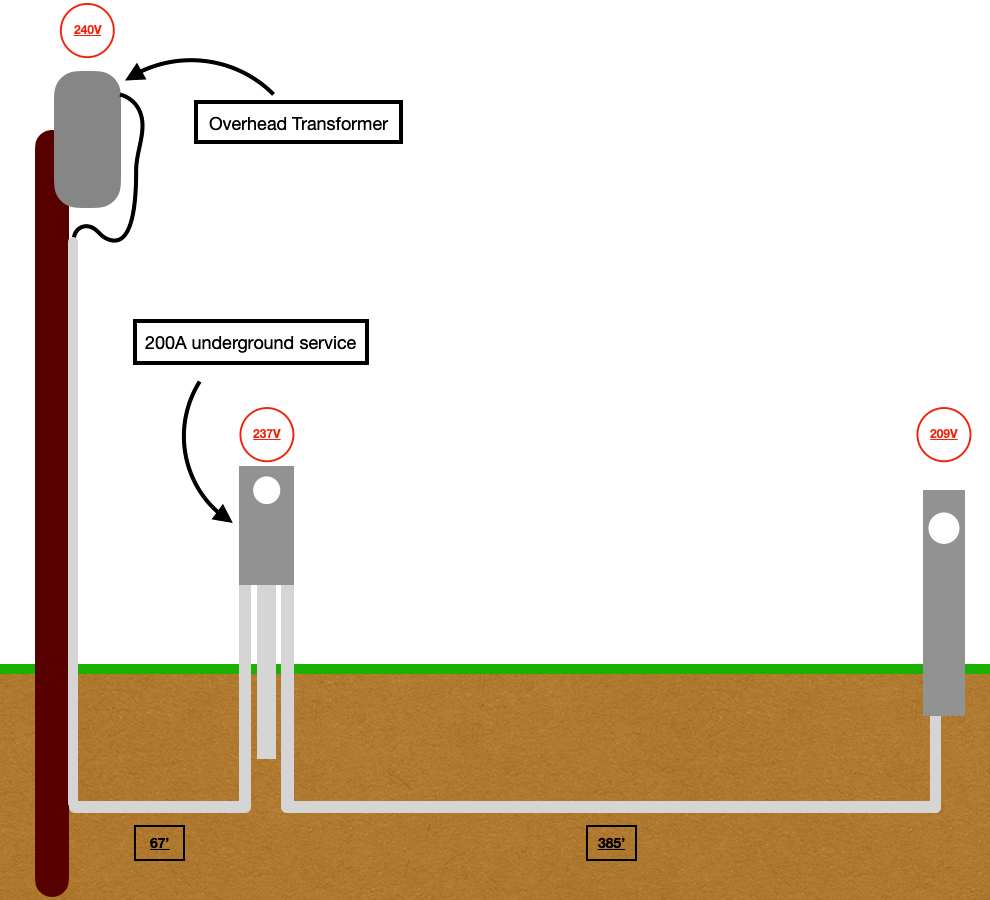
#8 copper wire feeding (1) 50A RV site 385’ away from the service location
13% total voltage drop = 209V at the pedestal
EXAMPLE 2: Daisy-chained 50A RV sites
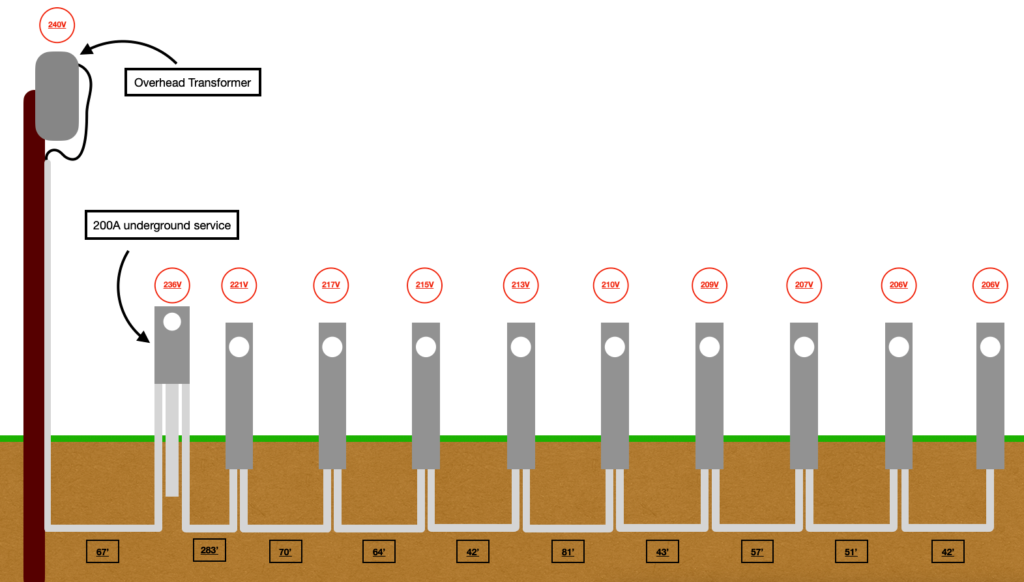
4/0 AL wire feeding (9) 50A RV sites
14% voltage drop = 206V at the last pedestal
Every electrical system experiences some voltage drop, but too much becomes a problem. In RV parks and campgrounds, voltage drop is most commonly caused by:
- Long electrical runs to pedestals
- Undersized wiring
- Loose or aging connections
- High loads during peak usage
When voltage drops below safe operating levels, RV appliances struggle to run, air conditioners overheat, and equipment fails more often. Park owners typically see this as intermittent site issues, especially during busy weekends.
Voltage Drop and Billing
One side of the voltage drop discussion that tends to get missed is how it impacts billing. If you are monitoring the usage of each site, but not factoring in the voltage of each individual site, you could be over-billing your customers, which can create compliance and legal exposure.
Let’s use the daisy-chained figure above as an example: If the first pedestal in the run is pulling 50A of load, you should bill them for 11.05kW (50A x 221V). On the other hand, if the last site pulls 50A, you should bill them for 10.3kW (50A x 206V). For this calculation’s sake, let’s say you bill monthly, they pull that load for 6 hours a day for 30 days, and your utility company bills you at a flat rate of $0.20 per kWh (kilowatt hour).
If you assume there is consistent voltage throughout the park (240V) for the same period of time and usage, the difference in what you bill your customer would be as follows:
- Assuming 240V throughout the system
- Sites 1 & 9 would both be billed = 2,160kWh x $.20 = $432
- Actual voltage per site
- Site 1 = 1,989kWh x $.20 = $398
- Site 9 = 1,854kWh x $.20 = $371
- Over-billing Site 1 by $61, and Site 9 by $34
This may not sound like a lot, but if you multiply an average over-billing of $48 per site per month by 150 sites, you would be over-billing for electricity at $7,200 per month, or a whopping $85,500 per year! Cut that number in half, and it’s still massive! It’s highly unlikely that the local municipality audits your electrical usage, but if you have a guest on-site who understands this concept, all it would take is a phone call, and it happens more than you would think.
How GMIs Expose Voltage Drop Issues
Unlike older RV setups, a GMI continuously tests for:
- Proper voltage
- Correct grounding
- Acceptable neutral-to-ground conditions
- Ground not exceeding the manufacturer’s voltage limits
GMIs do not just check a pedestal once; they check regularly. If voltage dips too low due to voltage drop, the GMI will disconnect the RV to prevent damage.
That means:
- Undersized wire runs can cause repeated disconnects
- Voltage sag during peak demand could shut down multiple RVs at once
- Hidden issues will become highly visible once GMI-equipped RVs arrive
Over the next few years, as newer RVs hit properties more and more, voltage drop will begin to affect guests at large instead of the small subset we’ve grown accustomed to working around.
Will RV Guests Notice This?
Yes, and they will think the park is at fault.
To guests, it looks like:
- “My power keeps shutting off”
- “This site must be broken”
- “This campground has bad power”
In reality, the GMI is doing its job to protect the RV. But the takeaway for guests is simple: they will expect the park to fix it quickly, or leave.
This is why voltage drop is becoming one of the most important issues for park owners to address ahead of widespread GMI adoption.
Why Voltage Drop Gets Worse During Peak Season
Voltage drop is most noticeable when:
- Every guest is running A/Cs or heaters
- The park is fully occupied
- Large rigs arrive for rallies or events
- Holiday weekends spike demand
Electrical systems that appear fine on a normal weekday can become unstable when demand suddenly increases. And of course, as every park owner knows:
Electrical issues never happen when the park is empty. They happen when the park is sold out. Once GMIs are active, these peak periods will be when disconnects happen most frequently.
What RV Park Owners Should Do Next
Voltage drop cannot be solved by replacing a breaker or tightening a screw. It requires a full-system evaluation to identify:
- Wire sizing issues
- Long-run distribution challenges
- Overloaded circuits
- Outdated or deteriorating connections
- Pedestal-specific voltage irregularities
- Transformer limitations
- Maintenance-related voltage loss
Here is how park owners can prepare:
- Schedule a professional assessment
Voltage drop is not something that you can measure in the field whenever you choose because you can’t simulate peak load on a broad scale. - Review wiring sizes and run lengths
Many older parks were not built with today’s RV power demands in mind. - Plan upgrades during off-season
Waiting until the busy season leads to emergency repairs, higher costs, and unhappy guests.
How Electrical Works Helps Park Owners Solve Voltage Drop
Voltage drop has become one of the most common issues we diagnose nationwide. Through hundreds of site evaluations, we’ve seen firsthand how small electrical shortcomings can escalate into major guest-facing problems as demand rises.
Electrical Works supports park owners by providing:
- Voltage drop testing with peak load considerations
- Full electrical system evaluations
- Rewiring and upgrades for long-run voltage stability
- Pedestal repairs and replacement
- Distribution system balancing
- Troubleshooting during peak demand
If you decide to rewire your property, there is no electrical contractor in the country better equipped to handle that project for you than Electrical Works. Electrical Works is the only tried-and-true, nationwide turnkey electrical contractor in the RV and MH industry. From design and engineering to managing the power company, to onsite installation, our 100% in-house staff has the specialized knowledge and experience to get the job done right. No shady change orders, no curve-balls, just a quality product, delivered on time at an industry-approved price point.
And with our Vice President and Master Electrician, Tristan Ciceri, serving on NEC Code-Making Panel 7, our leading team brings insight into how future safety standards will impact RV parks long before they take effect.
Electrical Works has completed more than 20,000 RV and MH sites and is licensed in over 20 states. Our ownership team has been working in the RV industry for a combined 45 years, giving us unmatched experience with the electrical challenges park owners face.
A Smarter, Safer Future for RV Parks
Voltage drop has always been a behind-the-scenes issue, but GMIs will shine the light on it. RV parks that prepare now will:
- Reduce guest complaints
- Improve electrical reliability
- Avoid costly emergency repairs
- Plan their CapEx budgets accordingly
- Stay ahead of upcoming electrical expectations
- Maintain safer, more consistent power delivery
Electrical Works remains committed to helping parks navigate this shift with confidence, clarity, and expert support, powering your park and your community forward.